Before any structured programme begins, there is the matter of form. Not fitness. Not volume. Not progression. Form — the quiet, exacting standard by which a movement either builds or undermines the body it is intended to serve. For the beginner, three movements account for the majority of what a first programme requires: the squat, the push-up, and the plank hold. Each of them is simple in description and demanding in practice.
The Squat: A Study in Hip-Knee Relationship
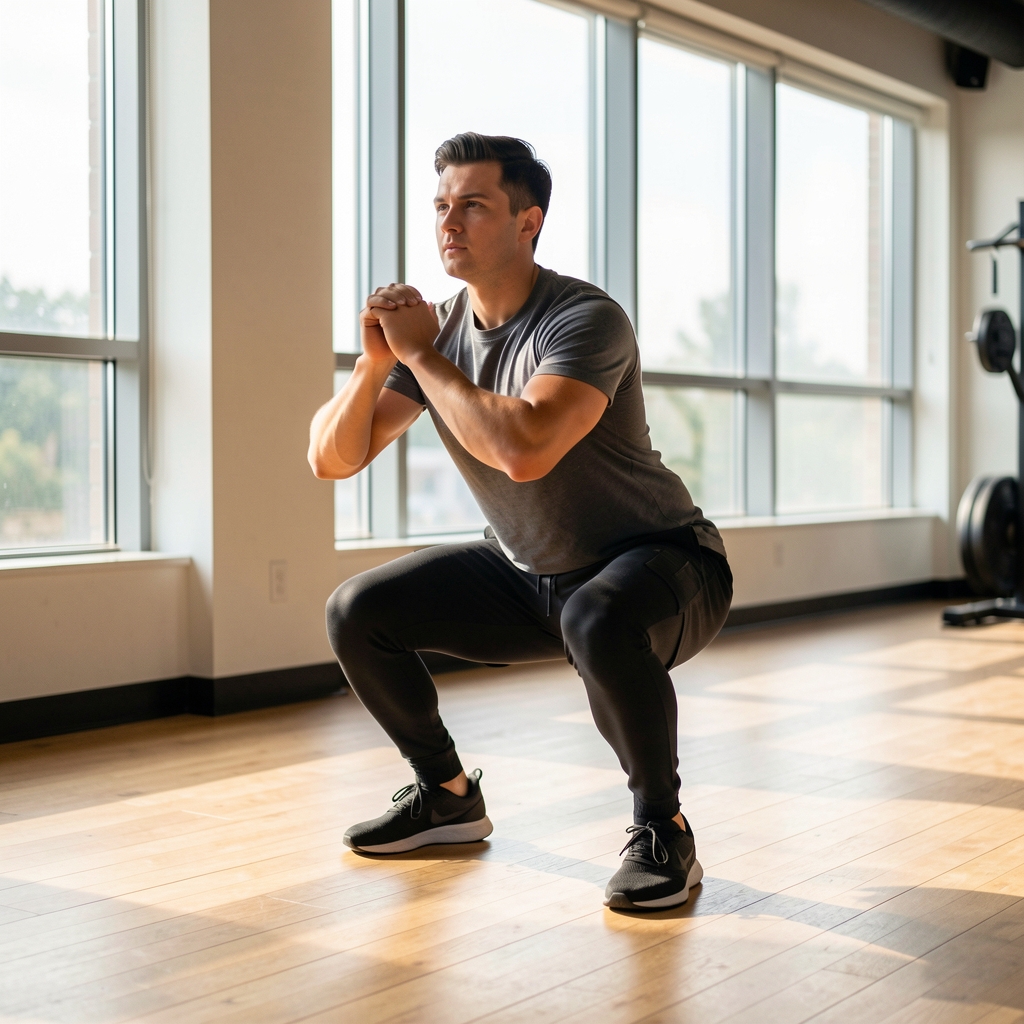
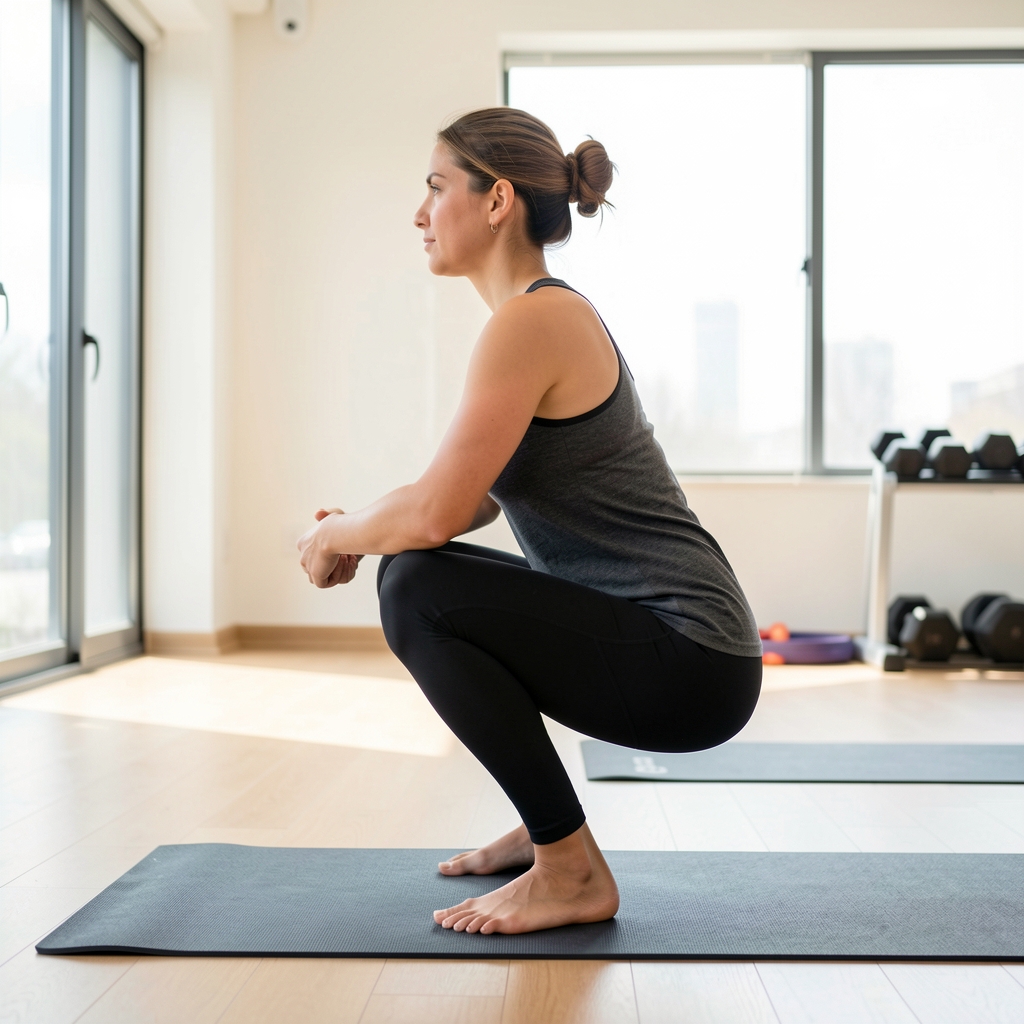
The bodyweight squat is the most frequently described and most frequently performed incorrectly of all beginner exercises. Its apparent simplicity — lower the body, raise the body — conceals a precise set of mechanical requirements that, when ignored, convert a productive movement into a harmful one. The core issue is not strength but alignment.
In a correctly executed squat, the hips descend below the level of the knees, the chest remains broadly upright, the knees track over the toes without collapsing inward, and the weight is distributed evenly through the foot from heel to ball. The lower back maintains its natural curve throughout. No part of this requires exceptional flexibility or strength at the outset. It requires attention, and attention requires slowness.
For most beginners, ten repetitions performed at a three-second descent, one-second pause at depth, and two-second ascent provides sufficient time to observe and correct the movement. This is not a training pace — it is a learning pace. The training pace arrives later, once the pattern has been absorbed. Published exercise science consistently supports the position that motor learning in new movement patterns is disrupted by speed, and that slowing the movement accelerates the acquisition of correct form over the first four to six weeks of a beginner programme.
The Push-Up: Entry Points and Progression
The push-up presents a different problem for beginners than the squat. Where the squat is frequently executed at the wrong depth or speed, the push-up is more often abandoned entirely — replaced by a modified version that does not build toward the full movement. The modified push-up, performed from the knees, is a legitimate starting point. It is not, however, a destination.
The transition from knee-supported to full push-up is gradual and measurable. The body is treated as a plank from the crown of the head to the knees in the modified version, and from head to heels in the full version. In both cases, the elbows trace a path rearward at approximately 45 degrees from the torso — not flaring outward at 90 degrees, which is a common error that shifts load into the shoulder joint rather than distributing it through the chest and upper-back musculature.
For a beginner's first four weeks, a set of five to eight modified push-ups performed with full attention to body position yields more benefit than twenty repetitions performed with the hips raised or collapsed. The increase from five to eight repetitions over four weeks is itself a meaningful measure of gradual progression — a concept that deserves more careful consideration than it typically receives in beginner guidance.
"Ten repetitions performed with correct form yield more lasting benefit than thirty performed carelessly. This is not a principle specific to beginners — it is a principle of movement."
Eleanor Whitfield — Ondavi Quarterly, February 2026
The Plank Hold: Duration and the Meaning of Stillness
The plank hold is the most misunderstood of the three foundational movements, in a specific sense: it is treated as a measure of endurance when it is better understood as a measure of position. A thirty-second plank held in correct position — hips level, core engaged, shoulders over wrists, neck neutral — is far more productive than a ninety-second plank held with the hips elevated or the lower back sagging.
For beginners, the forearm plank (on elbows rather than hands) reduces the load on the wrist joints and places the shoulder in a mechanically simpler position. Twenty to thirty seconds, three times, with forty-five seconds of rest between repetitions, constitutes a complete plank component for a first session. There is no benefit to extending the hold past the point at which position can be maintained.
The value of the plank hold extends beyond what it produces in the anterior abdominal musculature. It establishes, for the beginner, the experience of deliberate stillness under physical demand — a quality that transfers directly to the maintenance of correct position in the squat and push-up. This cross-training effect between the three foundational movements is not incidental. It is one of the reasons they are well-suited to a single beginner session.
The Warm-Up Sequence: Non-Negotiable and Frequently Omitted
No session of any length begins without a warm-up. This is a statement that appears in virtually every published exercise science framework for beginners and is violated in virtually every self-directed beginner programme. The warm-up is understood as optional. It is not. It is the preparatory work that allows the three foundational movements to be performed safely.
For a beginner's first programme, a warm-up of five to eight minutes is sufficient. The structure is: two minutes of light walking in place or stair climbing, followed by three to four minutes of gentle dynamic movement — leg swings, shoulder rotations, hip circles, gentle knee raises — followed by thirty seconds of easy bodyweight movement such as slow air squats or shallow knee bends. This sequence prepares the joint surfaces, raises the temperature of the relevant musculature, and shifts the nervous system's attention toward the physical task.
The cool-down stretch follows the same logic in reverse. Five minutes of static stretching — held positions targeting the major muscle groups used in the session — reduces acute post-session discomfort and is considered, across published movement literature, a standard component of any beginner routine. The hip flexor stretch, the hamstring stretch, the chest stretch, and the child's pose are sufficient for a post-session cool-down after a three-movement bodyweight session.
Rest Days and the Architecture of a First Programme
A beginner's first four-week programme is not three sessions per week on the premise that more sessions produce faster results. The session frequency and rest structure reflect the reality that adaptation — the process by which the body adjusts to new demands — occurs during recovery, not during exercise. Exercise provides the stimulus; rest provides the context in which the adaptation takes place.
Two rest days between the first and second session, and two rest days between the second and third, is a defensible structure for a beginner's first four weeks. Three sessions per week with two rest days between each is equally valid. The specific number matters less than the consistency — appearing for the session on the scheduled day, performing the movements correctly, and resting on the rest days.
The question of when to increase volume — more repetitions, more sets, fewer rest days — should not arise before the end of the fourth week. Before that point, the correct question is not "when do I add more?" but "have I maintained the quality of movement across all three sessions this week?" If the answer is yes, the programme is working. If the answer is no, the answer is not more sessions — it is more attention to the sessions already scheduled.
This is, in sum, the patient architecture of starting strength: three movements, performed correctly, with appropriate preparation and recovery, over a period measured in weeks rather than days. There is nothing dramatic about it. There is, however, something durable.
Articles published on Ondavi Quarterly are editorial in nature and reflect the writers' observations on everyday wellness practices. The content is not intended as professional advice, nor as guidance for the management of any specific condition. Readers with specific concerns about their daily routines are encouraged to speak with a qualified wellness professional.