Walking is among the most thoroughly documented forms of low impact activity available to someone at the beginning of a fitness journey. It requires no equipment beyond appropriate footwear, no instruction beyond an understanding of one's own pace, and no location beyond wherever one happens to be. For these reasons, it is also consistently underestimated as a meaningful first step towards an active lifestyle — treated as a placeholder for more demanding activity rather than as a legitimate programme in its own right.
Why Thirty Minutes and Not Twenty, or Forty
The choice of thirty minutes as the unit of a walking session is not arbitrary. It reflects a body of published exercise science that identifies thirty minutes of moderate-intensity walking as the threshold at which the cardiovascular system is engaged sufficiently to produce measurable adaptation over a sustained period of weeks. Sessions shorter than twenty minutes do not produce the same documented effect at the same frequency; sessions longer than forty minutes increase the likelihood of joint discomfort in a sedentary beginner, which in turn increases the likelihood of the programme being abandoned.
The figure of thirty minutes is, in other words, a practical optimum — long enough to be productive, short enough to be repeatable. This matters more than it might seem. The first four weeks of any beginner programme are not a test of physical capacity. They are a test of behavioural consistency. The question being answered is not "can this person walk for thirty minutes?" but "will this person walk for thirty minutes, three times per week, for four weeks in succession?"
For many beginners, the honest answer to that question is uncertain. Reducing the session length to twenty minutes might make the answer more likely to be yes — and a completed programme of twenty-minute sessions is of considerably more value than an incomplete programme of forty-minute sessions. The thirty-minute figure is a recommendation, not a rule, and it should be adjusted downward without hesitation if downward adjustment is what enables the programme to be completed.

Pace, Effort and the Question of What Counts
The question of pace is one that beginners tend to ask too early and too anxiously. The relevant measure at the start of a walking programme is not speed but perceived effort — a scale familiar from published exercise science in which a moderate effort corresponds to a pace at which conversation is possible but sustained speech is slightly effortful. This is the target zone for a thirty-minute walking session at beginner level.
What this means in practice varies considerably between individuals. For one person, it may correspond to a pace of five kilometres per hour on level ground; for another, on a route with inclines, it may correspond to three and a half. The specific number is secondary. The perceptible effort is primary. A beginner who walks at perceived moderate effort for thirty minutes, three times per week, is conducting an effective programme regardless of what a fitness tracker or mapping application reports about pace or distance.
Step count is a secondary metric — useful as a broad indicator of daily activity goals but not as a measure of session quality. A session of 3,200 steps on a hilly route at moderate effort is of more value than a session of 4,000 steps on level ground at a pace that does not engage the cardiovascular system meaningfully. The habit of counting steps is a reasonable tool for self-awareness; it becomes counterproductive when it replaces attention to effort.
"A completed programme of twenty-minute sessions is of considerably more value than an incomplete programme of forty-minute sessions. Duration is a variable; consistency is the constant."
Tobias Ashcroft — Ondavi Quarterly, March 2026
The Fixed Route: Why Repetition Serves the Beginner
There is a practical argument for walking the same route for the first four weeks of a programme that tends to be overlooked in beginner guidance, which often emphasises the value of variety. The argument runs as follows: a fixed route, walked at the same time of day on the same days of the week, becomes a habit by a well-documented mechanism. The route is the cue; the walk is the behaviour; the sense of having completed the session is the reward. Varying the route during the establishment phase disrupts the cue-behaviour-reward sequence before it has stabilised.
This does not mean walking the same route indefinitely. After four weeks, when the habit has been established and the behaviour is occurring reliably, variation is entirely appropriate and is supported by published research on long-term adherence to walking programmes. The principle is simply that variety, during the first month, introduces a decision that a beginner need not make.
There is also a secondary benefit to the fixed route: familiarity with the route enables the beginner to observe changes in their own experience of it. The hill that required effort in week one may require noticeably less effort in week four. This is direct evidence of gradual progression — visible and felt without the need for a measurement device or a structured test.
Footwear and the Single Equipment Consideration
Walking requires no equipment beyond appropriate footwear, but the qualification "appropriate" is worth examining. Appropriate footwear for a walking programme means footwear that fits correctly across the widest point of the foot, provides some form of cushioning at the heel, and has a sole that does not slip on wet pavement. It does not need to be a running shoe, a trail shoe, or a shoe marketed specifically for walking. It needs to fit correctly and to be comfortable across thirty minutes of continuous use.
The most common footwear error among beginner walkers is using shoes that fit correctly when standing but produce discomfort within fifteen minutes of walking. This is often the result of insufficient width across the toe box — a fit issue that tends to be concealed by the static nature of trying on shoes in a shop. For a walking programme, shoes that feel slightly loose in the shop are generally preferable to shoes that feel precisely fitted, because the foot expands slightly with sustained activity.
Cotton socks of moderate thickness are a reasonable companion to any walking shoe. Socks that are too thin allow the foot to move within the shoe, generating friction; socks that are too thick reduce the available space within the shoe, producing compression. Moderate thickness, in a fabric that manages moisture effectively, is the relevant standard.
Tracking Progress and Knowing When to Progress
A walking programme of thirty minutes, three times per week, conducted over four weeks, constitutes a first block of structured low impact activity. At the end of four weeks, the question of progression arises: should the session length increase, the frequency increase, or neither?
The answer depends on a single observation: is the programme still effortful? If the thirty-minute sessions at moderate effort feel significantly easier at week four than they did at week one, the programme has produced adaptation and the beginner is ready to increase either session length (to forty minutes) or frequency (to four sessions per week). If the sessions still feel moderately effortful, continuing the existing programme for a further two weeks before reassessing is appropriate.
The mistake to avoid is the instinct to progress rapidly because the initial programme feels manageable. A manageable programme, sustained over time, is the correct objective. The purpose of the first programme is not to reach the next level as quickly as possible — it is to establish the habit of regular movement as a fixed component of a week. Once that habit is stable, progression can be undertaken with the confidence that the foundation it rests on is solid.
An Activity Journal: The Case for Written Records
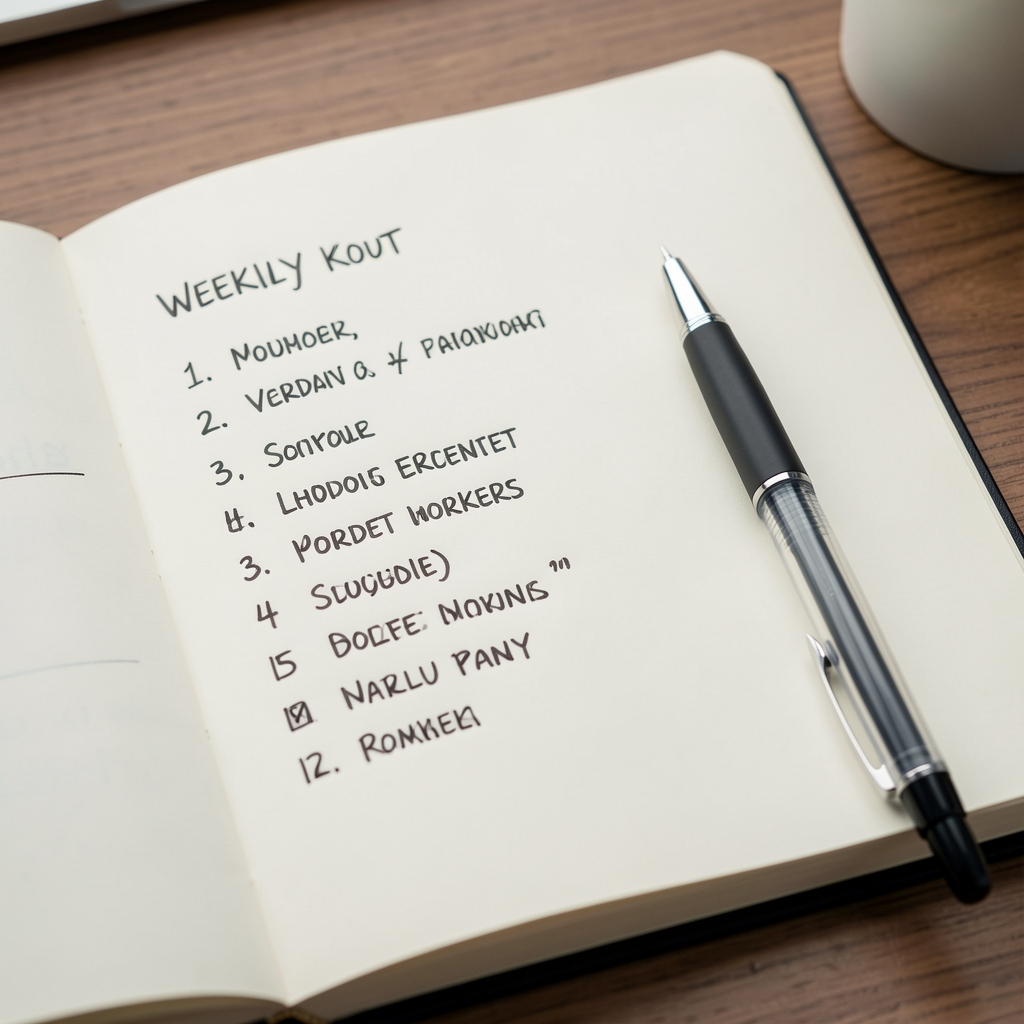
The activity journal is among the most consistently underused tools available to a beginner. Its function is not motivational, as it is often presented, but evidential: a written record of completed sessions provides the beginner with direct evidence that the programme is being conducted. At week four, reviewing a journal that records twelve completed sessions is a different experience than relying on memory alone.
The journal need not be elaborate. Date, duration, route (if fixed, simply "usual route"), and a one-word effort notation ("light", "moderate", "heavy") constitutes a complete session record. This takes approximately thirty seconds to complete after a walk and provides, over four weeks, a record of twelve data points that tell the story of the programme clearly.
Milestone tracking — noting the first session completed, the first week completed, and the four-week completion point — adds a secondary layer of evidence. The value of this is not sentimental. It is the value of a documented progression: a record that the beginner can refer to when considering the next programme, and that provides context for any setbacks or missed sessions that occur along the way.